
Scaffolding Services in Clifton, Staten Island, NY
Coastal-Exposed, Mixed-Use & Residential Scaffolding
Clifton is one of Staten Island's most layered construction environments — sitting between residential neighborhoods, transit-influenced corridors, and coastal exposure zones. This combination creates a setting where scaffolding work is shaped not just by buildings, but by wind, movement, and street activity intensity.
Request a Free Estimate Today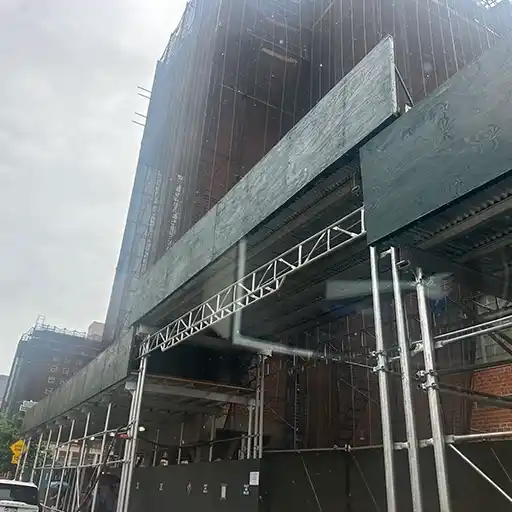
Residential Calm vs Active Corridors
This town does not behave like a single construction zone. It operates in two distinct patterns.
Inside residential streets, the environment is quiet, with older homes that require periodic exterior maintenance such as roofing, chimney repair, and façade restoration. These projects typically need stable, long-duration access systems that do not disturb surrounding homes.
But just a few blocks away, corridors influenced by transit movement and small commercial activity create a completely different condition. Here, scaffolding must accommodate pedestrian flow, storefront access, and continuous street visibility.
This contrast is what defines this town's construction identity: quiet interiors and high-movement edges.
Wind Exposure & Construction Stability
One of the most important factors in this town is its exposure to coastal wind patterns. Even though it is not directly waterfront in every section, airflow from nearby open zones affects scaffold stability more than in inland Staten Island neighborhoods.
This impacts how structures are anchored and reinforced, especially on taller façades or buildings positioned on open streets. In these conditions, scaffolding systems are typically adjusted for additional lateral stability, particularly during longer-duration residential or mixed-use façade projects.
Residential Streets and Older Buildings
The majority of this town's interior streets consist of older residential buildings, including detached homes, semi-attached properties, and low-rise apartment structures.
These buildings often require recurring exterior work rather than full redevelopment. Common projects include roof repairs, siding replacement, chimney restoration, and masonry maintenance. In these residential pockets, pipe scaffolding is commonly used because it adapts well to uneven façades and older structural layouts.
The key challenge here is not the complexity of height, but working within tightly spaced residential blocks without disrupting neighboring properties.
Mixed-Use Corridors & Constant Access
Where residential zones meet active streets, this town transitions into mixed-use environments. These buildings often have commercial or service units at ground level with residential spaces above. This creates a constant requirement to maintain access during construction.
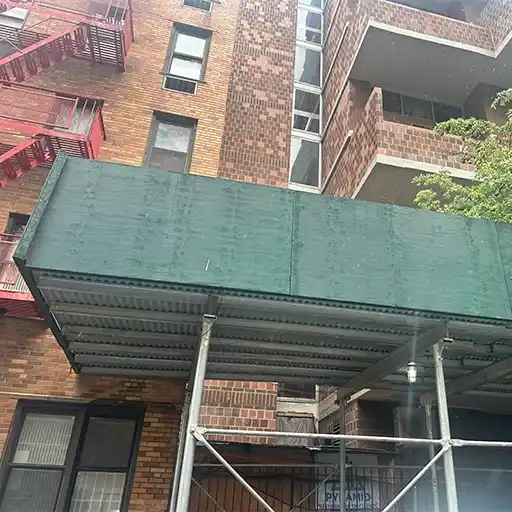
Scaffolding in these areas is typically installed in a way that preserves storefront entry, pedestrian movement, and visibility while allowing safe access to upper exterior surfaces. In many cases, sidewalk protection systems are used to ensure public safety while overhead work is in progress.
Construction Behavior in Transit Zones
Parts of this town are influenced by nearby transit movement and higher pedestrian activity. This changes how scaffolding projects are executed. Instead of full-block occupation, installations are often segmented to allow continuous movement along sidewalks and curb areas.
Suspended access systems are sometimes used for upper-level work where ground space is limited or must remain fully open. The key requirement in these zones is maintaining flow without interruption, even during active construction.
Three Overlapping Conditions
Safety in this town is shaped by three overlapping conditions:
Interior streets
Property protection and stable installation in quiet blocks.
Mixed-use corridors
Separation from storefronts and continuous foot traffic.
Wind & coastal edge
Reinforced structural stability for open zones.
This combination makes this town a multi-condition safety environment rather than a uniform one.
How Scaffolding Projects Are Managed in Clifton
Every project begins with identifying the type of environment the building sits in. Once the condition is understood, scaffolding is designed specifically for that setting rather than using a standard configuration.
Installation is carried out in controlled phases to minimize disruption, particularly in areas where pedestrian or residential access must remain active. During the project, systems remain stable under changing conditions such as wind variation or traffic flow, and adjustments are made only when necessary based on site behavior.
Built for Clifton's mixed conditions
We provide essential access and site safety solutions for construction projects — all adapted to the dual nature of this neighborhood.
From quiet residential interiors to wind‑exposed edges, every system is selected for terrain, building type and surrounding activity.
Emergency Scaffolding & Service Coverage
Emergency scaffolding is often required in this town for older residential buildings or structures affected by weather exposure. Common situations include roof instability, façade damage, or sudden structural concerns identified during inspection or storms. Because some areas are wind-sensitive, emergency stabilization must prioritize both structural security and environmental resistance.
Scaffolding services extend throughout all parts of Clifton, including residential interior streets, mixed-use corridors, and exposure-affected zones closer to open wind corridors and transit-influenced streets. Each location requires a tailored approach based on building type and surrounding environmental conditions.
Learn More About Us